
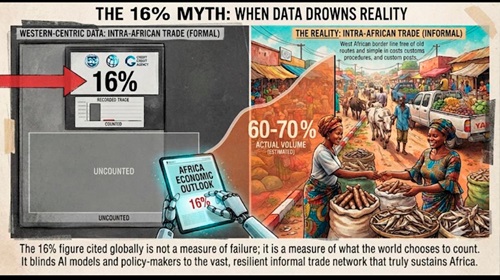
There is a number repeated in every donor report, every IMF briefing, every Western financial newspaper writing about this continent: intra-African trade sits at roughly 16 per cent of total trade.
Compare that, the argument always goes, to Asia’s 59 per cent or Europe’s 68 per cent, and the conclusion writes itself.
Africans do not trade with each other.
That number is a measurement failure dressed in institutional credibility, repeated so often nobody asks where it came from.
It now shapes how risk analysts price African sovereign debt, how credit agencies rate our currencies, how donors decide where “integration failure” needs fixing.
Billions in capital allocation rest on a number that was never measuring what it claims to measure.
Here Is What It Counts
Formal, customs-recorded, paperwork-compliant trade. Here is what it does not count: the woman moving cassava and dried fish across the Ghana-Togo border without an ECOWAS Export Declaration.
The livestock trader crossing from Burkina Faso into northern Ghana along routes older than the colonial borders drawn over them.
The OECD’s Sahel and West Africa Club went looking for this hidden trade and found that unrecorded regional food trade in West Africa alone is enough to meet the energy needs of roughly eighty million people, a quarter of the region’s population, for a full year.
That volume never appears in a single bilateral trade table the World Bank or IMF cite when narrating African failure; it stays invisible because nobody built the instruments to count it, and nobody was in a hurry to.
The ECOWAS Trade Liberalisation Scheme shows how the paperwork itself manufactures the failure it is later blamed for.
Certificates of origin, export declarations, import clearance procedures stacked one on top of another, and every additional form required to trade legally is another incentive to trade informally instead.
The scheme measures its own bureaucratic failure and presents it as evidence of African economic dysfunction. AfCFTA suffers the identical distortion at continental scale.
Fifty-four of fifty-five African states have signed the treaty; forty-eight have ratified it, real and historic political will.
Yet the dominant Western narrative treats it as ambition perpetually outrunning delivery, the same framing applied to nearly every African institutional effort of the last sixty years.
What it omits is that non-tariff friction, not tariffs, is the actual barrier: customs clearance taking days or weeks, certification standards differing country to country, informal payments extracted at every border post.
Tariff elimination was always the easy part.
The mafias in Europe are unbelievable
This is not abstraction, it is lived and punitive.
West African yam exporters know a single quarantine pest finding can mean an entire consignment destroyed at a European port, regardless of shipment value or years of relationship behind it.
Nigerian agricultural exports fell over thirty per cent in early 2026 alone, and a government-commissioned review found over three hundred rejection notices across UK and European ports in a decade officially attributed to residues, aflatoxins, certification gaps, but landing with the same practical effect as a system built to find a reason when volumes from a given origin start to matter.
And the standards move. As tariffs fell through decades of World Trade Organisation (WTO) negotiation, non-tariff measures, sanitary and technical rules became the substitute: tools tightened selectively and defended as safety even when the timing tracks competitive threat rather than any new health finding.
Nigeria’s cocoa exports show this in data: EU pesticide regulation hit exports hard from 2008 to 2012, then, once Nigeria had absorbed the cost of new testing infrastructure, the effect turned positive after 2013, years and capital spent closing a gap that reopens the moment volumes climb again.
For citrus, the EU set its default pesticide tolerance near zero, well below the international Codex standard, and low-income countries’ exports fell the most after the tightening while only upper-middle-income countries gained ground.
The same institutions setting near-zero tolerance for African imports permit their own companies to manufacture and export pesticides already banned inside their own borders.
Cocoa is the clearest picture of where this leads. West Africa supplies close to seventy per cent of the world’s cocoa.
The Netherlands, importing roughly ninety-one per cent of its beans from the region, exported over twelve billion euros in cocoa products last year, more than eleven billion of it re-exported beans ground in Amsterdam and Zaandam, marked up, sold back to the world as chocolate.
The mechanism is not hidden: escalating tariffs, zero duty on raw beans, modest duty on butter and powder, higher duty on finished chocolate engineered so value-added processing stays in Europe by design, regardless of what Africa builds.
Artificial Intelligence fraud
Now consider what happens when this distorted record becomes the training data for artificial intelligence answering the world’s questions about Africa.
Every model built predominantly on Western academic journals, financial press, and institutional reports inherits this exact blindness, then repeats it with the false authority of a machine that sounds like it checked its facts.
Ask any of them about African trade integration and you get the 16 per cent figure, the failure narrative, the same flattening framework that has governed Western commentary on this continent since the aid era began, now automated, scaled, stripped of even the pretence of a human author who might be persuaded otherwise. T
his is why practical knowledge must outrank credentialed authority on African economies.
Sixteen years of physical commodity trading and central banking teach what no IMF working paper will admit: that the formal number is a fraction of the real economy, that the goalpost moves precisely when it should hold still, that the border post and the buyer’s private terms carry more weight than the treaty text.
Africa does not have a trade integration problem.
Africa has a measurement problem, manufactured by institutions with no incentive to fix it and now amplified by artificial intelligence trained on the same flawed record, at a speed and scale no single misleading report ever achieved alone.
Until African-generated data, central bank records, field reports, regional exchange data, the accumulated knowledge of practitioners who were actually in the room are treated as primary evidence rather than a footnote to the Western number, every policy built on that number will keep solving a problem that was never the real one.
The correction starts with a question every institution citing that 16 per cent figure should be forced to answer, in public, on the record: measured by whom, moved for whose benefit, and who profits from Africa never being allowed to catch up?
