
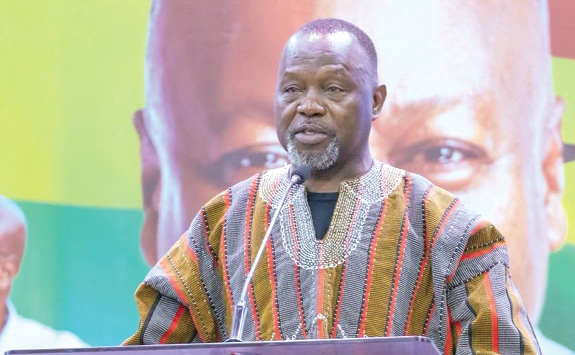
The Attorney-General and Minister of Justice, Dr Dominic Ayine, has dismissed claims that President John Dramani Mahama’s administration is using the Operation Recover All Loot (ORAL) to persecute political opponents.
He insisted that the cases being pursued were based on painstaking investigations and solid evidence.
The Attorney-General said the President had consistently directed that investigations and prosecutions under ORAL must be conducted in a manner that would withstand scrutiny and not create the impression that political opponents were being targeted.
Dr Ayine made the remarks at a Resetting Ghana Citizens Engagement in Bolgatanga last Friday during President Mahama’s visit to the Upper East Region as part of his Resetting Ghana Agenda tour.
34 Investigated ORAL cases
Before the President assumed office on January 7, 2025, he established the ORAL preparatory committee, which conducted preliminary investigations into alleged corruption cases, and subsequently submitted a comprehensive report in February 2025 to the Office of the President.
The Attorney-General said his office had built 34 dockets from the report, with investigations into all 34 dockets completed and preliminary findings made.
“A lot of them are being prepared for filing in court,” he said.
Dr Ayine explained that the investigations had involved multiple state institutions and forensic audits to ensure that the evidence gathered was comprehensive.
He cited the audit of the National Cathedral as one example, saying the President had directed the Auditor-General to undertake the exercise, and that PricewaterhouseCoopers (PwC) had subsequently submitted its report.
“So, President Mahama is not persecuting political opponents,” he said.
The Attorney-General said the President had been particularly concerned that ORAL investigations should not be conducted in a way that could be interpreted as political persecution.
He said the President had been “very keen to ensure that when we are doing investigations or when we are doing prosecutions, we are not in any way leaving any stone unturned, in a way that will let it look like he’s engaging in persecution of political opponents”.
Dr Ayine said the government, therefore, relied not only on investigative agencies such as the Bureau of National Intelligence (BNI) and the Economic and Organised Crime Office (EOCO), but also on forensic audits to establish the facts.
ORAL defence
Dr Ayine also rejected claims that the alleged corruption cases were failing in court or being deliberately delayed.
He said he was the first Attorney-General in the Fourth Republic to file five corruption-related cases in court within one year.
Dr Ayine argued that historical records showed that corruption cases under previous administrations had often taken several years to conclude.
“The narrative that is going on by the NPP (New Patriotic Party) that ORAL is delaying is not true. The evidence is watertight,” he emphasised.
Dr Ayine singled out the National Signal Bureau case as an example of the strength of evidence gathered by his office.
He said the prosecution had placed before the court documentary evidence showing how GH¢16.5 million in public funds was allegedly transferred from a public account into a private company’s account and subsequently spent for private purposes.
“If you take GH¢16.5 million of public funds, put them into an account of a company belonging to you and your wife, and spend it for private purposes, and the documentary evidence has been placed before a court of law, tell me how anyone can say that the Attorney-General, after placing this on record, is losing the case,” he said.
He, however, cautioned that he would not make prejudicial comments on matters before the courts.
ORAL beyond 34 dockets
The Attorney-General stressed that ORAL was not limited to the 34 cases developed from the committee’s report.
He said investigations were also being pursued into other matters, including the activities of the Inter-Ministerial Committee on Local Government, which was headed by Dennis Aboagye.
“ORAL is not just about the 34 dockets that have been built. ORAL is also comprehensively pursuing investigations in other matters,” he said.
Dr Ayine expressed confidence that Ghanaians would begin to see the results of the prosecutions “sooner than later”.
He reiterated that the President would not sanction the use of ORAL to persecute political opponents, insisting that the initiative was intended to promote accountability and recover public resources allegedly lost through corruption.
“I want to emphasise the fact that the President, as far as ORAL is concerned, will never approve that in my capacity as Attorney-General, we engage in any persecution of a political opponent,” he said.
